


Old money interior design is not a mood board. It is not a hashtag trend that emerged because someone discovered their grandmother’s upholstered chair looks good on camera. It is a set of values about permanence, quality, and restraint that happen to have very specific furniture attached to them.
The rooms we’re talking about were built to last. The pieces in them were chosen to outlive whoever bought them. And the defining material, across centuries and continents, is mahogany. If you want to understand old money interior design, you start there.
What Old Money Interior Design Actually Means

The phrase has been diluted to near-uselessness on social media, where it tends to mean “beige, preppy, and expensive-looking.” The real version is something else. Old money rooms are not decorated. They accumulate. A drawing room that’s been in the same family for three generations doesn’t look curated. It looks inhabited. The furniture has weight, the wood has depth, and nothing was bought to perform wealth.
This distinction matters when you’re shopping for furniture, because it tells you exactly what to avoid. The moment a piece is trying to look expensive, it fails the brief. Old money furniture looks expensive because it is expensive and always has been. The patina, the carved joints, the solid wood construction: these are evidence of how things were made when making them any other way was simply not how it was done.
In practice, the furniture forms that define old money interior design are Georgian and Regency English pieces: Chippendale dining chairs, mahogany pedestal tables, Chesterfield sofas, breakfront bookcases, partners desks, and flame mahogany sideboards. These forms were designed by the most accomplished craftsmen in England during the 18th and 19th centuries. They ended up in the great houses of Britain and the early American republic, and they never stopped being the reference point for how serious furniture looks.
The Dining Room: Where Old Money Interior Design Announces Itself
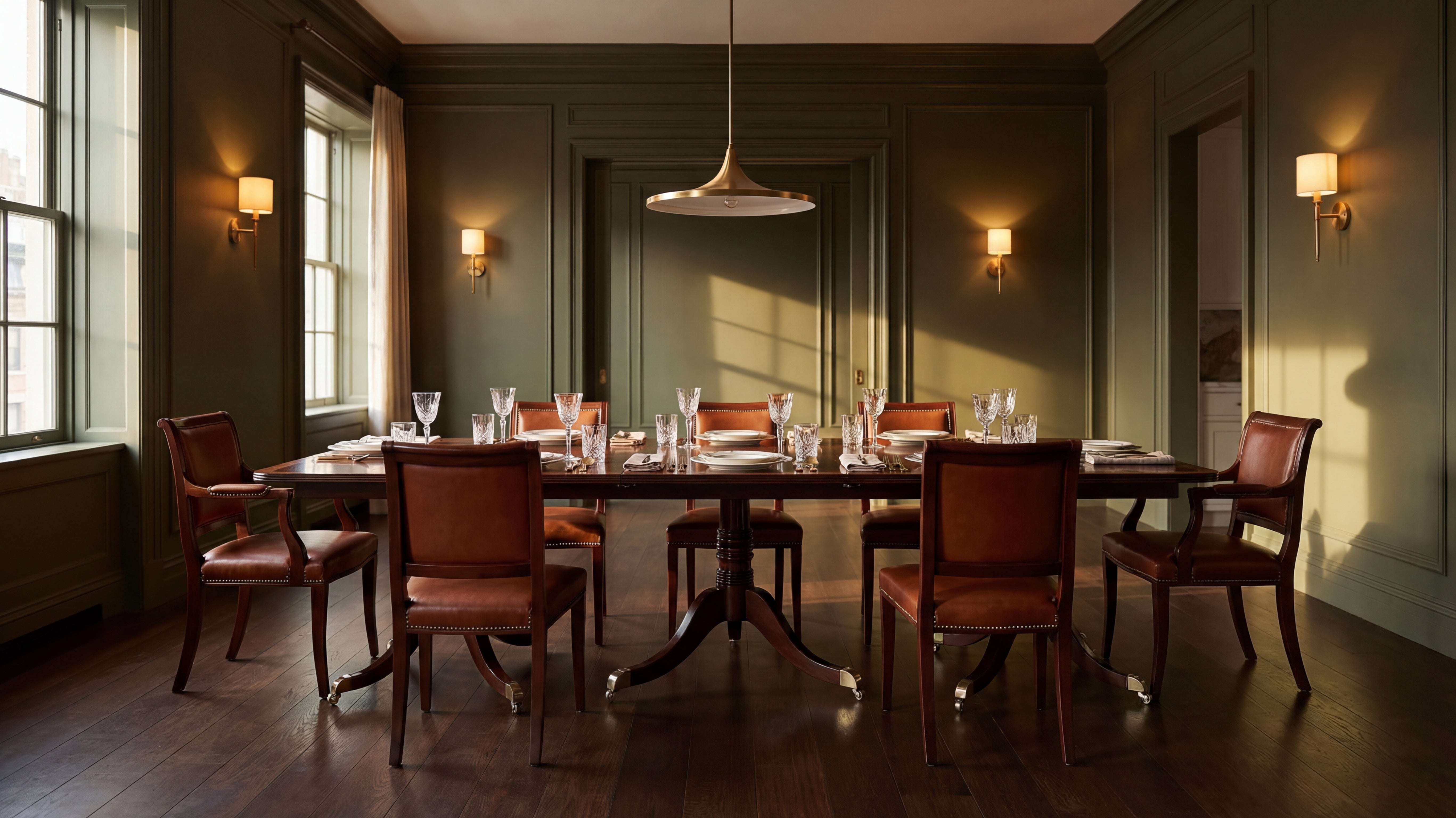
No room does more work in old money interior design than the dining room. A proper dining room is a declaration. It says that this household gathers formally, that meals are occasions, that the table you’re sitting at was made to last beyond you.
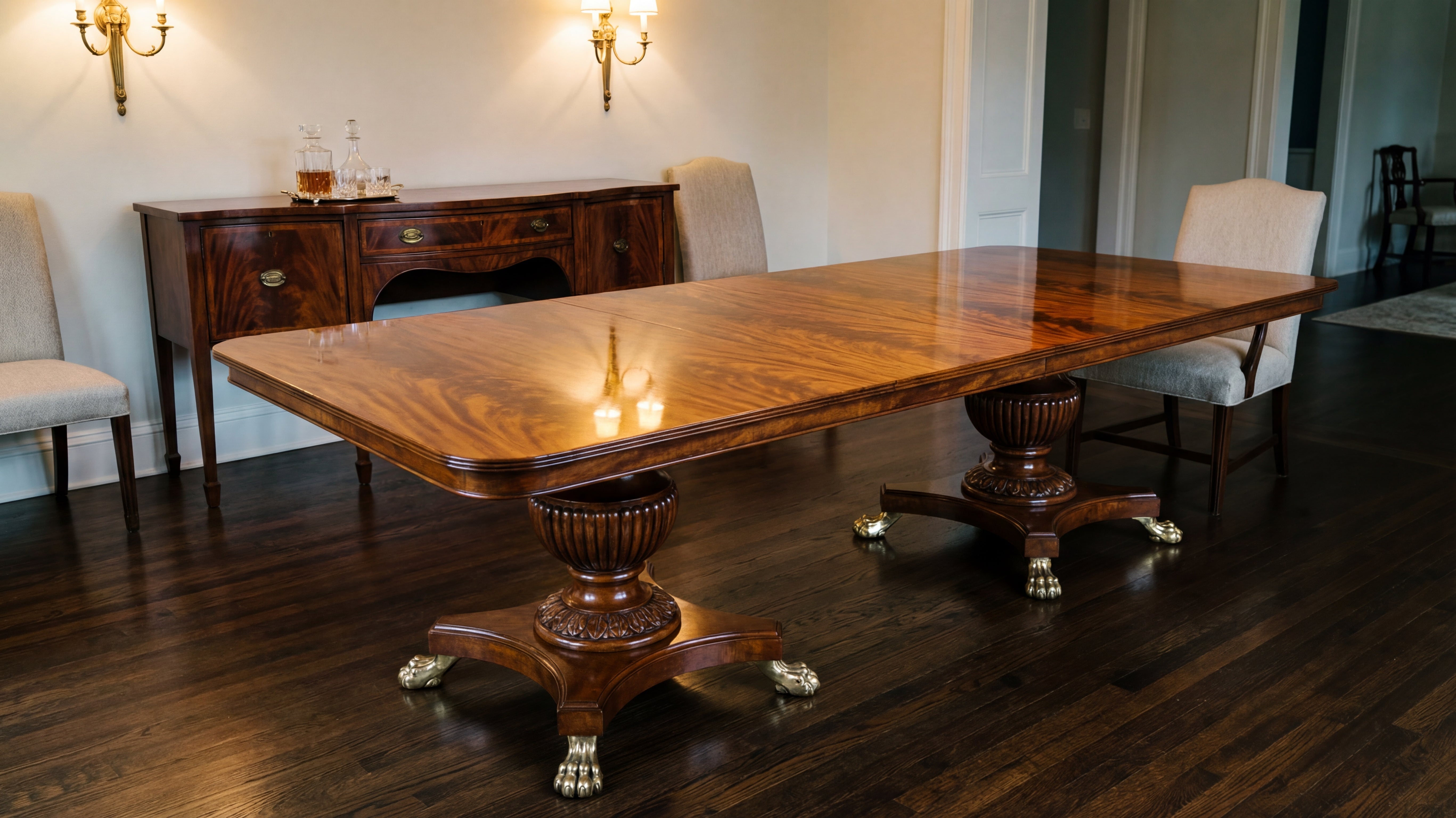
The centerpiece is always a mahogany dining table. Not a “mahogany-finish” table. Not a hardwood veneer over particleboard. Solid mahogany, cut from genuine Swietenia macrophylla, turned on legs that have been shaped by hand and finished to a depth that takes months to build up. A double pedestal mahogany dining table seats eight to ten without leaves and expands with hidden mechanisms to seat twelve or fourteen when needed. That is the form Thomas Chippendale and his contemporaries popularized. It is still the form that defines a formal dining room in 2026.
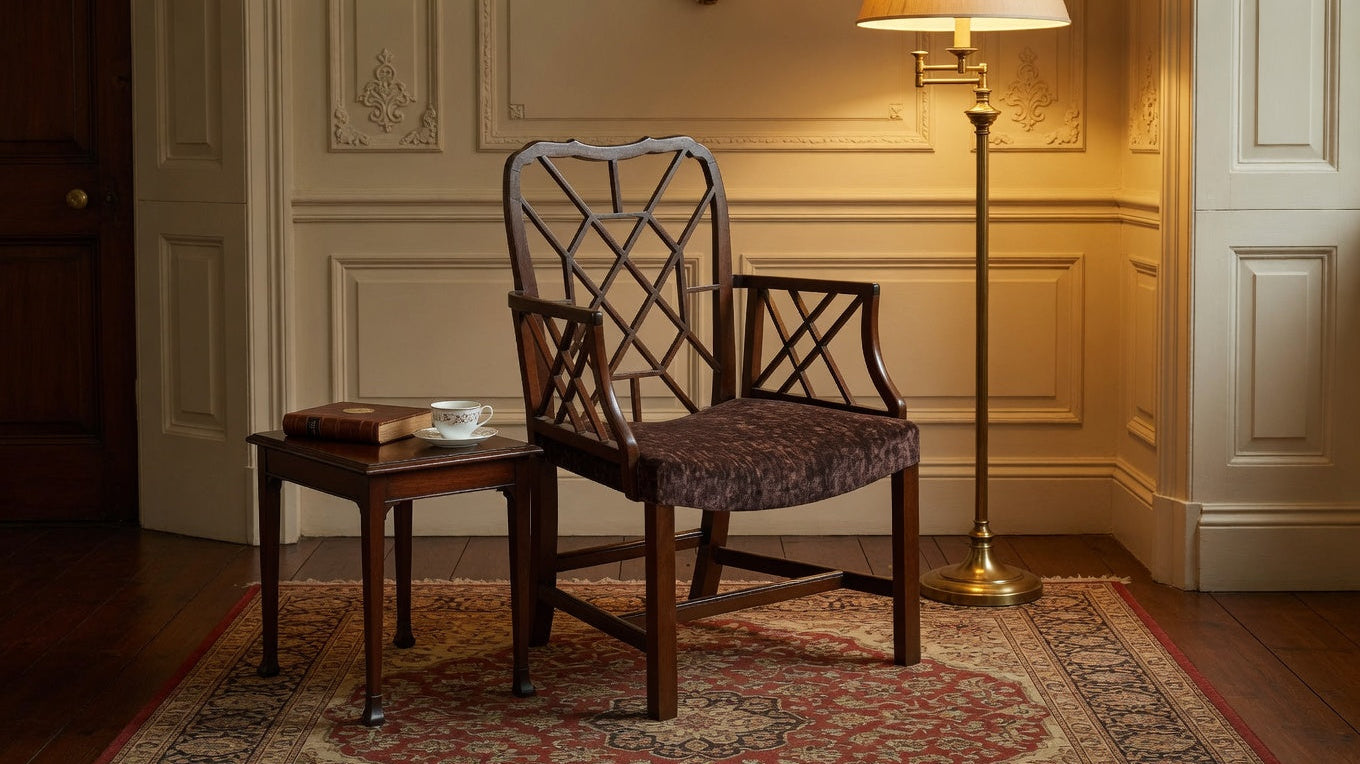
The chairs that surround it carry equal weight. Chippendale dining chairs with their carved splats, ball-and-claw feet, and solid mahogany frames are the most recognizable form in English furniture history. You have seen them in paintings, in historic house museums, in every serious dining room that has ever been photographed for a magazine. They are recognizable because the design is correct. The proportions work at every scale. The carving demonstrates craft without theatrics. The seat height and pitch are, even by modern ergonomic standards, comfortable.
For a complete old money dining room, the sideboard matters as much as the table. A flame mahogany sideboard with cross-banded inlay and brass hardware provides the storage for silver, linens, and serving pieces that formal dining requires. The flame grain on the drawer fronts, where the wood’s natural figure catches the light and seems to move, is one of the most beautiful things furniture timber produces. You cannot fake it convincingly. When you see the real thing, you know.
To go deeper on dining room furniture choices, the post on how to choose a dining table that lasts 100 years covers material quality and construction in detail.
The Living Room: Chesterfields, Wingbacks, and Dark Wood

Old money living rooms do not subscribe to open-plan thinking. They are rooms with purpose: for conversation, for reading, for receiving guests. The furniture reflects this. Seating is arranged for engagement, not for sight lines to a television. The upholstery is leather or heavy fabric. The wood frames are dark.
The Chesterfield sofa is the defining piece. Its button-tufted leather, rolled arms level with the back, and solid mahogany or walnut legs have appeared in English great houses since the 18th century. Its depth, typically 36 to 40 inches, creates a seat you can actually settle into rather than perch on. The construction, with eight-way hand-tied springs and a hardwood frame, is why originals from the Victorian era are still in use today. The Chesterfield sofa dimensions guide walks through the measurements in detail for anyone sizing a piece for their room.
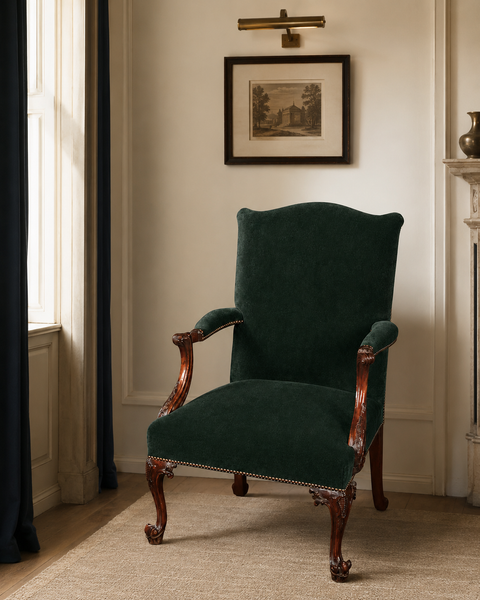
Flanking the Chesterfield, a pair of Chippendale wingback chairs in leather or a heavy cotton ground with a traditional pattern closes the room. Wingbacks were designed for warmth before central heating existed. The wings kept drafts off the face. The high back supported the head during long evenings beside the fire. In a modern room, they read as exactly what they are: purposeful furniture from a time when purpose came before aesthetics.
The side tables, console tables, and occasional tables in an old money living room are in the same family. A Regency console table with brass inlay and tapered legs belongs against a wall below a gilded mirror. It does not need to do anything except exist correctly. And it does.
For more on how dark wood furniture is returning to prominence in 2026, the piece on dark wood furniture in the living room gives the full picture.
The Library: Old Money’s Most Personal Room
If the dining room is a declaration, the library is a confession. What you keep on your shelves, and what you sit in while you read them, is as personal as any room in a house.
Old money home library furniture is specific. It starts with mahogany bookcases with glass doors: Georgian breakfronts with arched astragal glazing, adjustable shelves behind brass-latched doors, and a depth that holds real books without looking shallow. These pieces were built to floor-to-ceiling heights in Georgian townhouses, and they translate equally well to a dedicated library room or a study alcove. The scale is part of the effect. Low shelving looks like storage. Floor-to-ceiling shelving looks like a library.
The desk is the room’s other anchor. A leather-top partners desk in mahogany, with its two banks of drawers and its hand-tooled leather writing surface, was the desk of choice for barristers, landowners, and financiers from the 18th century onward. The design assumption is that two people can work from opposite sides, which says something about how serious correspondence was conducted. In a modern home, the form reads as settled authority. It is not trying to impress. It was built to work.
The seating in a proper library is a leather button-tufted library chair with a high back and generous seat. Aniline leather, which takes a patina over time and becomes more beautiful with age rather than less, is the material of choice. The library chair is meant to be used for decades. The leather should show it.
For a deeper look at putting together a traditional library or study, creating the perfect home office library covers the room-building process from shelving to seating. The dark academia furniture guide approaches the same space from a slightly different angle and is worth reading alongside it.
Why Reproduction Matters More Than Original Antiques
Old money interior design is associated with antiques, but the most serious old money rooms are not necessarily filled with them. Original 18th-century pieces are museum objects: fragile, expensive, and nearly impossible to use at a dining table without anxiety. What old money interiors actually contain is furniture made to the same standards, by the same methods, using the same materials.
The case for antique reproduction furniture comes down to this: a reproduction Chippendale chair made today by a skilled craftsman using solid mahogany, hand carving, and traditional joinery is structurally stronger than most surviving originals. The original has two hundred years of wood fatigue, repaired joints, and refinished surfaces. The reproduction has none of that. It will acquire its own patina over the next hundred years and arrive at the same place.
The honest version of old money furniture is not about age. It is about permanence of design and integrity of construction. Mahogany furniture is worth the investment not because mahogany is fashionable but because it is one of the few furniture materials that improves measurably over decades. The grain tightens. The color deepens. The surface of a well-made mahogany piece at thirty years looks better than it did when new.
This is the core claim of old money interior design, and it is a claim that only holds if the furniture is actually made this way. A pressed-wood credenza with a mahogany film will not deepen with age. It will delaminate. The rooms that accumulate meaning over generations are filled with things built to survive them.
Putting an Old Money Room Together
The principles are not complicated:
Start with the anchor piece. In a dining room, the table. In a living room, the Chesterfield. In a library, the desk or the main bookcase. Get that piece right first, because everything else will follow from it in scale and proportion.
Stick to a period family. Georgian and Regency pieces live together naturally. Chippendale chairs work beside a Hepplewhite sideboard. A Regency console belongs in the same room as a Georgian dining table. Mixing these with modernist or mid-century pieces requires a light hand and real confidence to pull off. When in doubt, stay within the tradition.
Choose dark over light. Old money rooms are not bright. They are warm. The mahogany is dark honey to deep reddish brown. The walls are often painted in deep tones: forest green, navy, burgundy, or the kind of off-white that looks like it absorbed a hundred years of candlelight. The lighting is concentrated and warm. Lamps, not overhead fixtures, create the pools of light that period furniture asks for. The quiet luxury and traditional furniture guide covers the material restraint that underlies this approach.
Let the pieces do the work. Old money rooms are not over-accessorized. A breakfront bookcase with a proper library behind it does not need objects on top of it. A Chesterfield with good cushions does not need throw pillows spelling out intentions. The furniture earns its place by being what it is.
Where to Start
If you are furnishing from scratch, the dining table is the place to begin. A proper mahogany dining table that seats eight to twelve will be the piece every dinner guest remembers. From there, a set of Chippendale chairs, a flame mahogany sideboard, and the room becomes a room.
If you are adding to an existing space, a Chesterfield sofa in dark leather transforms a living room more than almost any other single purchase. Its presence is authoritative without being aggressive. It works in rooms that already have traditional pieces and in rooms that don’t.
If you have a room that wants to be a library, start with the bookcases. Once they are in and filled, the desk and the chair will find their places naturally.
The furniture at EGA Home is made to the same specifications as the Georgian originals, in the same wood, by craftsmen trained in the same traditions. Every piece can be made to custom dimensions, which means the table, the bookcase, and the desk can be built for your rooms rather than the other way around.
That is what old money interior design has always meant: furniture made for the specific house, by people who understood that permanence was the point.