


The Dumb Bedroom: Why Luxury Design's Boldest Move in 2026 Is Removing Every Screen
There is a bedroom trend circulating among architects, interior designers, and a certain type of very-online, very-deliberate client that sounds, at first, like a joke.
The dumb bedroom.
No television. No smart speakers. No phone chargers on the nightstand. No screens of any kind, sometimes extending to blackout curtains thick enough to block the glow from a neighbor's window. A few designers in San Francisco and New York are reportedly specifying WiFi-shielding plaster for clients who mean it seriously. Elle Decor ran the headline earlier this year. It has not stopped being discussed since.
The irony, which is not really an irony at all, is that the most technologically deliberate room in a luxury home in 2026 is built almost entirely from furniture that was designed in the eighteenth century.
Mahogany four-poster beds. Solid wood nightstands with hidden storage. Carved armchairs that do not connect to anything. This is what the tech-free bedroom furniture conversation keeps arriving at. Not because tradition is fashionable again (though it is), but because the furniture forms that predate electricity happen to be exactly what this kind of room requires.
Why "Dumb" Is the New Premium
The language is deliberate. Silicon Valley coined "dumb phones" as a term of art for devices that do not surveil, manipulate, or interrupt. Interior designers borrowed the logic and applied it to rooms.
A dumb bedroom does not mean an empty one. It means a room where every object earns its place through physical presence and purpose rather than connectivity. A room designed to produce sleep, rest, and the particular quality of attention that only silence and darkness can sustain.
The Wall Street Journal reported in late 2025 that high-net-worth buyers were increasingly asking architects to specify "screen-free zones" as part of primary suite design. Not as a budget measure. As an amenity. The absence of technology, in a home where technology is everywhere else, has become a luxury signal in the same category as handmade finishes and natural materials.
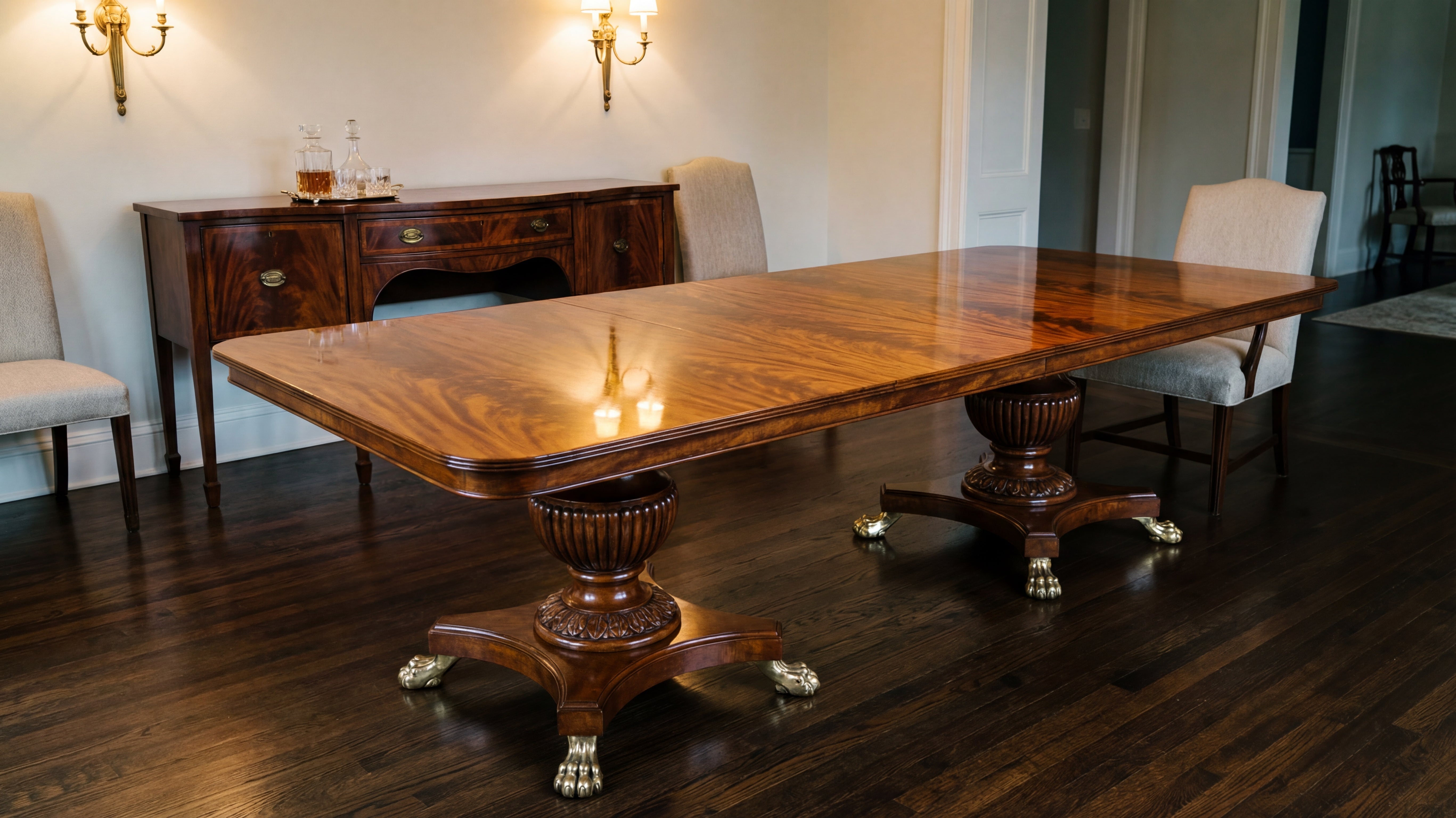
Mahogany furniture fits this signal precisely. It is warm, dense, and visually complete in a way that manufactured furniture is not. It does not need a charging cable. It does not need an update. It needs a good cloth and occasional wax, and it will outlast everyone in the room.
That is the pitch. And increasingly, buyers are accepting it.
The Four-Poster Bed as Room Anchor
The four-poster bed is the defining piece of the tech-free bedroom, and not by accident. A canopy bed frames space. It creates an enclosure within a room, a room within a room, that draws attention inward and downward rather than toward walls and screens.
A hand-carved mahogany four-poster with reeded posts and a shaped tester does something that even the best platform bed cannot: it gives the eye somewhere to go that is not a screen. The carved detail at each post corner, the way the grain catches warm light from a bedside lamp, the visual weight of the canopy frame. This is furniture that commands a room.
At EGA Home, our four-poster beds are built to custom dimensions from solid Honduras mahogany, with carving done by hand and each post turned individually. A king-size four-poster requires a ceiling of at least nine feet to read correctly. Ten or eleven feet is better. If you are working with a standard eight-foot ceiling, a half-tester or a low-canopy frame achieves a similar effect without overwhelming the room.
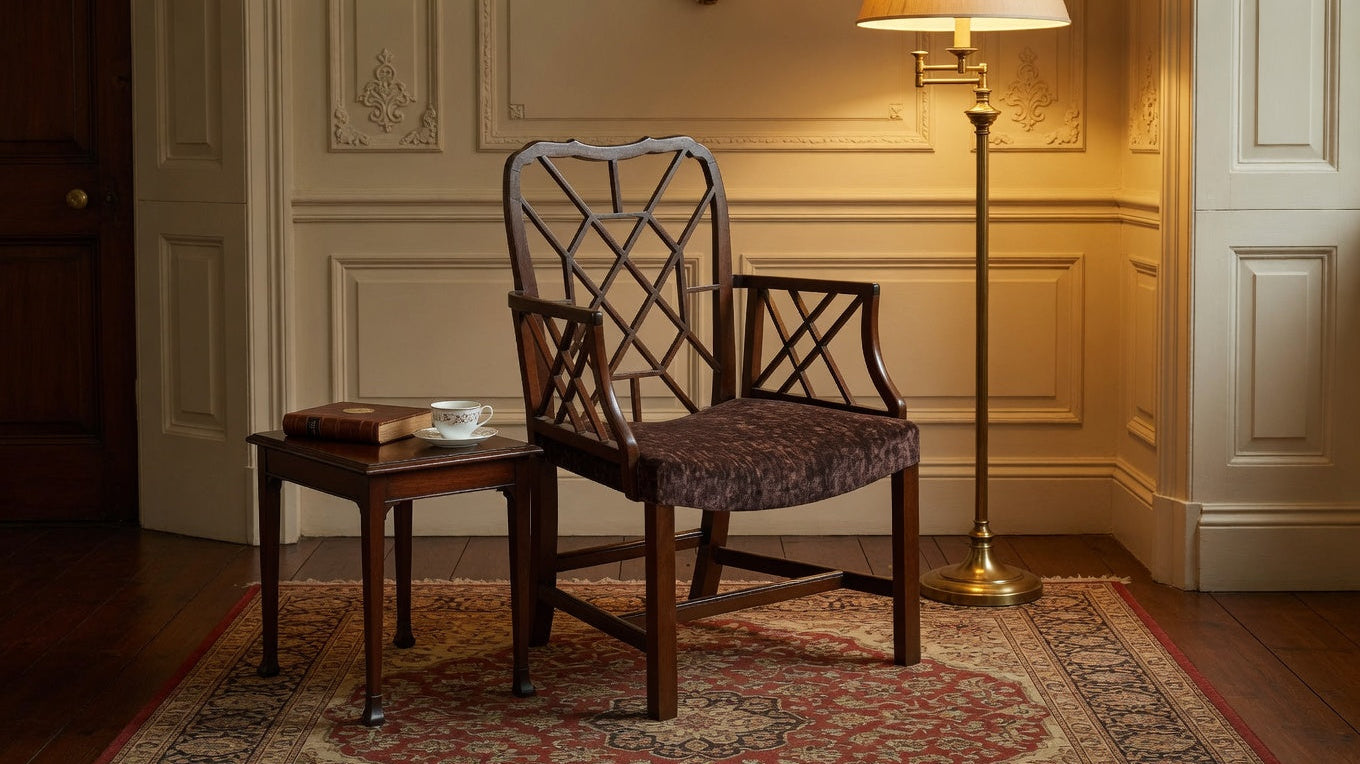
The headboard is the detail that separates a thoughtful four-poster from a theatrical one. A Chippendale-style fretwork headboard, pierced and carved, is light enough visually to work in most primary suites. A solid arched panel in flame mahogany reads heavier and more architectural. Either direction works. The wrong answer is a headboard with an integrated USB port.
Nightstands That Do the Job Without Advertising It
The nightstand problem in a tech-free bedroom is real. Most people, even people who want screens out of the bedroom, still need to charge a phone somewhere. The solution is not to ignore this; it is to solve it invisibly.
A solid mahogany nightstand with a hidden drawer fitted for a charging outlet maintains the visual integrity of the room while accommodating the reality that most clients will charge a device somewhere nearby, even if they leave it face-down and on silent. The charging infrastructure lives inside the furniture. From the room, you see only the nightstand: the turned legs, the carved apron, the warm grain of the top surface.
This is a detail we build into custom nightstands at EGA Home on request. It requires coordination with an electrician during installation, but the result is a nightstand that looks exactly like a Georgian antique and functions exactly like a piece of contemporary furniture, without the two ever being visible at the same time.
The nightstand surface itself matters in a tech-free bedroom. A leather-top nightstand, in the tradition of the Regency writing table, gives the surface warmth and a tactile quality that bare wood or glass does not. A small lamp with a warm-toned bulb. A book. A glass of water. That is the composition. It should not require explanation.
Dressers and Chests That Are Just Furniture
One of the quieter pleasures of the tech-free bedroom brief is that it gives the dresser permission to be a dresser again.
For the past decade, bedroom storage furniture has been shaped largely by the logic of minimalism and built-ins. The freestanding chest of drawers read as clutter. The tall wardrobe as excess. What replaced them were fitted wardrobes with integrated lighting and, in more ambitious installations, integrated screens for climate control, lighting management, and entertainment.
The tech-free bedroom inverts this. Freestanding furniture is now a choice rather than a compromise. A serpentine-front chest in flame mahogany, with hand-cut dovetail drawers and brass bail pulls, is not a storage compromise. It is a piece of furniture with a claim on the room that a fitted wardrobe cannot match.
A pair of matching chests flanking a window, or a tall highboy as the visual anchor of the room's long wall, gives the bedroom the same layered authority that a well-furnished living room has. The furniture does not disappear into the architecture. It asserts itself, which is precisely what a room designed to hold your attention needs.
This connects to the broader old money design principle: rooms that feel genuinely furnished are rooms that have been accumulated and considered, not specified as a package. The old money interior design guide covers this logic in detail. A primary suite built on freestanding mahogany case pieces reads inherited. Fitted wardrobes with hidden screens read as a hotel.
The Chair in the Bedroom Corner
Every bedroom that is being used correctly has a chair in it.
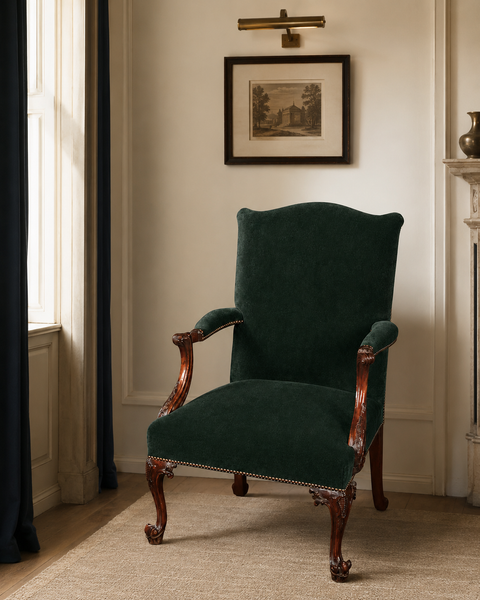
Not a desk chair. Not an accent chair selected for its photograph. A chair that is actually used. For reading, for dressing, for the few minutes of sitting at the end of the day before lying down. A chair that exists in the corner of the room not as decor but as a piece of furniture with a job.
In a tech-free bedroom, this chair does more work than it does in a connected room. Without a television to orient toward and a phone to pull from a nightstand, the chair becomes one of the room's active centers. It is where you sit with a book. Where you look out the window. Where you exist in a room that is designed for human-scale activity.
A button-tufted leather library chair in dark mahogany reads correctly here. So does an upholstered wingback with carved cabriole legs. Either gives the corner the visual weight it needs to feel intentional rather than incidental. The chair should be large enough to actually sit in comfortably, which eliminates most of what is sold as an accent chair and points instead toward the reading chairs and tub chairs in the EGA Home bedroom collection.
A small side table next to the chair, sized for a lamp and a book, completes the composition. This is furniture that existed before screens and will exist after them. That is not an argument for nostalgia. It is an argument for furniture that has already proven it works.
Lighting Without Overhead Glare
The tech-free bedroom brief has implications beyond furniture. The lighting logic that makes sense in a screen-oriented room (overhead LEDs, color-temperature controlled fixtures) works against the goals of a dark, rest-oriented space.
The furniture choices drive the lighting choices. A four-poster bed that frames the sleeping area calls for warm, low-intensity light at the bed level, not overhead illumination. Bedside lamps with incandescent-equivalent bulbs, in the 2700K range or warmer. A single lamp in the reading chair corner. Possibly a small lamp on the dresser surface.
None of this is new. It is how bedrooms were lit before electricity offered alternatives. The result is a room that reads warm and contained, where the light pools around objects rather than washing the space evenly. It makes the mahogany furniture look better. It makes the room feel like a room rather than a stage set.
The dark academia design guide covers this lighting philosophy in the context of a library, but the principles translate directly to a bedroom: warm pools of light, shadow as a design element, the visual weight of dark wood made richer by contrast.
What "Custom" Means in This Context
A tech-free bedroom built on custom mahogany furniture is not a one-size-fits-all project. The room's dimensions, ceiling height, window placement, and door swing all affect which pieces work and which do not. A king four-poster that reads beautifully in a fourteen-by-sixteen-foot room overwhelms a twelve-by-twelve.
This is where custom sizing matters practically, not just aesthetically. A chest of drawers built two inches narrower to clear a door swing. A pair of nightstands sized to the height of a custom mattress. A bed frame with post height calibrated to the ceiling rather than defaulting to the standard dimensions.
At EGA Home, every bedroom piece is built to order and every dimension is negotiable. We have built four-poster beds for rooms with seven-and-a-half-foot ceilings (posts cut and tester proportion adjusted), nightstands for beds with thirty-six-inch-high mattresses, and dressers in non-standard widths to fit specific wall runs. The point of custom furniture is that the room determines the furniture, not the other way around.
The quiet luxury guide frames this well: the difference between furniture that feels right in a room and furniture that feels like it was ordered from a catalog is almost always proportion. When the furniture fits, it disappears into the room. When it does not, it announces itself in all the wrong ways.
The Business Case for Getting This Room Right
There is a practical case for the tech-free bedroom that goes beyond design preference.
Sleep researchers have been documenting the impact of screen light on sleep quality for years. What is new is the luxury interpretation of that research: not that screens are harmful in some abstract health sense, but that the bedroom is the one room in the house where the investment in a genuinely screen-free environment has a measurable return in daily quality of life.
A bedroom that produces better sleep, that begins and ends the day without the friction of notifications and ambient screen glow, is not a design exercise. It is an investment in how you function. The furniture is the infrastructure for that investment.
Custom mahogany bedroom furniture, built to last and sized to the room, is also a one-time purchase at a price point that compares favorably to a decade of purchasing and replacing mass-produced alternatives. The four-poster bed in solid mahogany will not be replaced. The nightstand with hidden charging infrastructure will not be updated when the software changes. These pieces do not have a software version. They have a grain pattern and a patina, and both improve with time.
That is the argument for the dumb bedroom, stated plainly. It is not about rejecting technology. It is about creating one room where technology serves the room's purpose invisibly, and everything visible is furniture that was built to last.