


The Formal Dining Room Is Back. Here's How to Build One Worth Using Every Night.
For about fifteen years, the formal dining room was the room we were supposed to feel guilty about. Too much space, used too rarely, a relic of a time when people set the table with silver they polished themselves. Designers told us to knock the wall down. Lifestyle writers suggested turning it into a home office or a playroom.
Then something shifted.
This year, interior designers across the country are fielding the same request: clients want their dining room back. Not a casual eat-in nook, not a banquette jammed against an island. A proper room, with a table that seats eight, chairs you sit up straight in, a sideboard loaded with everything you need to pour a drink, and walls dark enough to make dinner feel like an occasion.
The formal dining room comeback is real, it's design-confirmed, and if you're thinking about it, you're not behind. You're right on time.
Why the Formal Dining Room Is the Room of 2026
The cultural signals have been building for a while, but 2026 is when they converged.
The rise of what people are calling "hostingcore" is part of it. After years of casual, low-friction entertaining, a significant cohort of homeowners decided they wanted to host differently. Not just a gathering. A dinner. Something that requires a seating chart and candles and a reason to bring out the good glasses.
The open-concept backlash is the structural driver. When your dining area is an extension of your living room, which is an extension of your kitchen, every meal feels like a continuation of everything else. There's no psychological separation. No arrival. Designers who spent a decade championing open plans are now documenting clients asking for walls, doors, and rooms that close.
And then there's what we might call the investment instinct. The buyers who are equipping formal dining rooms today are not doing it frivolously. They're making a deliberate choice to put resources into a space built around gathering, one that will outlast trends because it's grounded in something older than trends: the human impulse to sit down together and eat well.
If you're designing this room in 2026, here is what the best ones have in common.
The Table Anchors Everything
Start here and work outward. Every other decision in a formal dining room derives from the table, because the table is why the room exists.
For a room meant to seat eight comfortably, you want a table that measures at least 84 inches long. For ten to twelve, 108 to 120 inches. If your room needs to flex, an expandable table with concealed leaves gives you that range without compromising the silhouette when the leaves are stored.
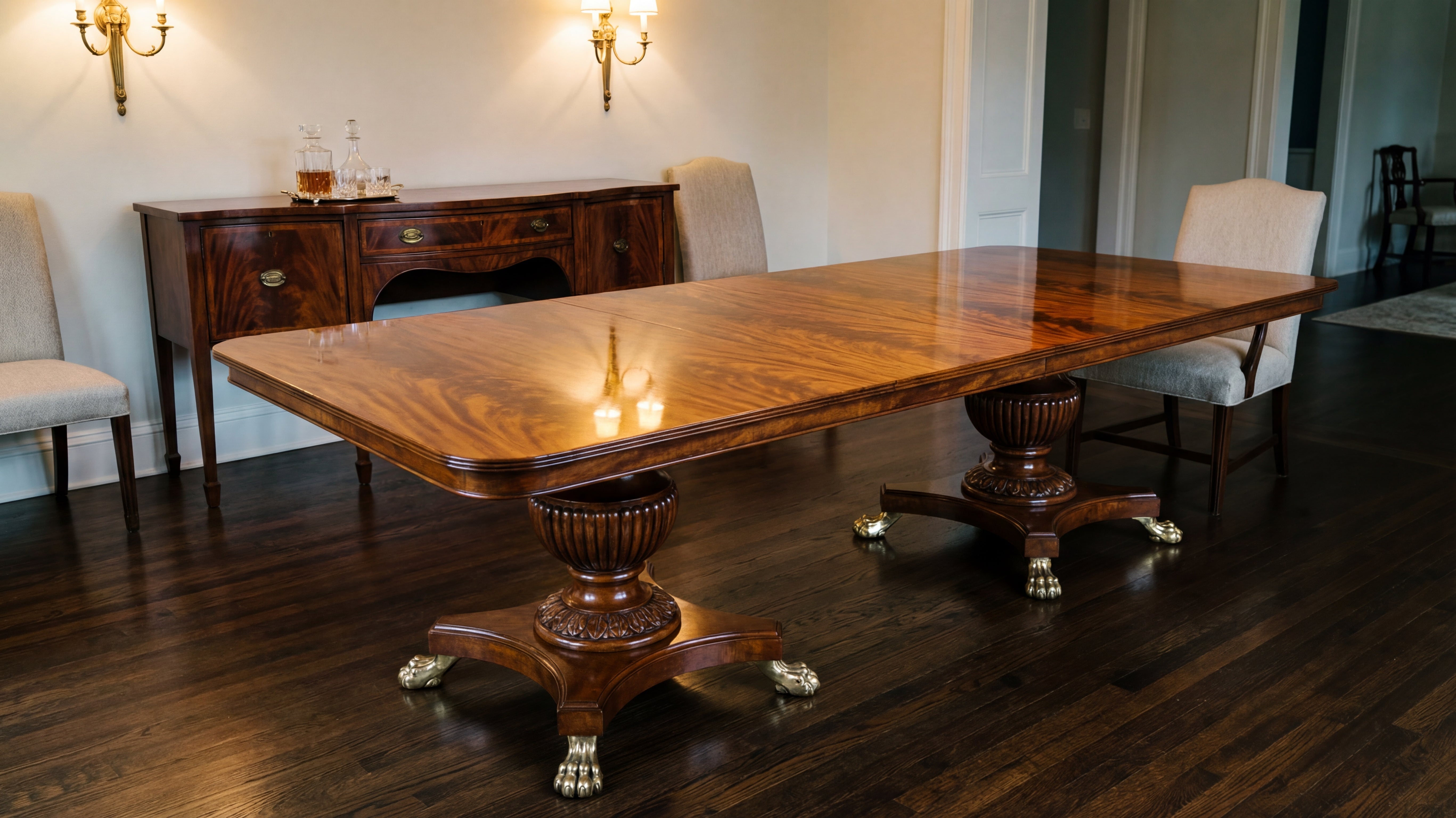
The current design consensus is moving hard toward solid dark wood. Mahogany continues to be the reference material, for good reasons. The grain structure of genuine mahogany produces a depth of surface that no veneered or engineered product can replicate. Under candlelight, it reads as something alive. When designers talk about wanting a moody dining room, a richly grained mahogany table is doing most of that work.
The pedestal base has become the preferred form for formal rooms, and the double or triple pedestal specifically. It solves the leg problem elegantly: no one has to straddle a corner post, which means you can seat the room without negotiating. The classic double-pedestal mahogany dining table, a form refined during the Georgian era and reproduced to exacting standards today, is the foundation of nearly every room in this category worth showing.
If you want to go deeper on what to look for in a table that will last a hundred years, we've written a full dining table buying guide that walks through construction, wood selection, and what questions to ask any maker before ordering.
Browse EGA Home's dining tables for double and triple pedestal mahogany options made to custom dimensions.
Chairs: The Room's Most Personal Decision
The chairs are where the room becomes yours.
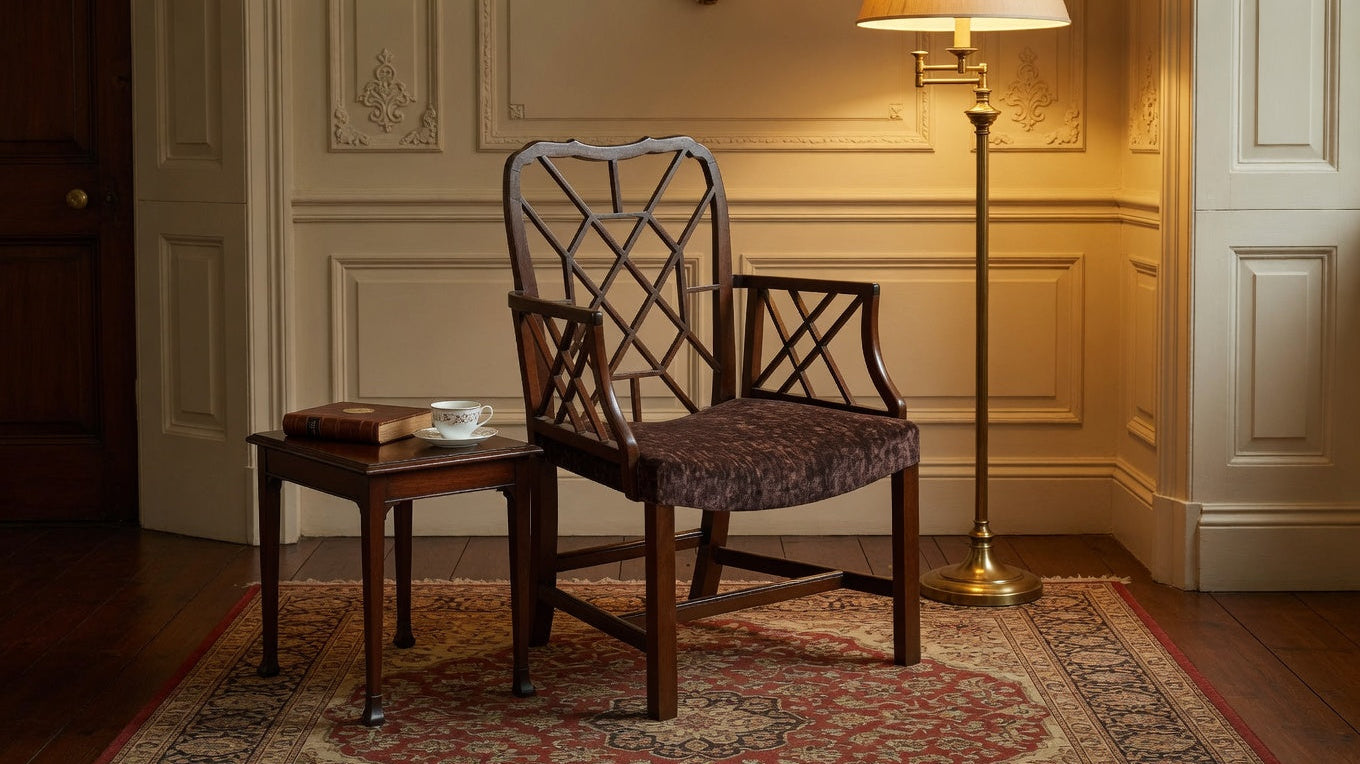
There is a reason the Chippendale dining chair has been in continuous production for nearly three hundred years. The proportions are right. The carved splat creates visual interest without visual noise. The ball-and-claw foot connects the chair to centuries of furniture-making tradition without asking the room to feel like a museum. When you sit in a well-made Chippendale chair, you feel it.
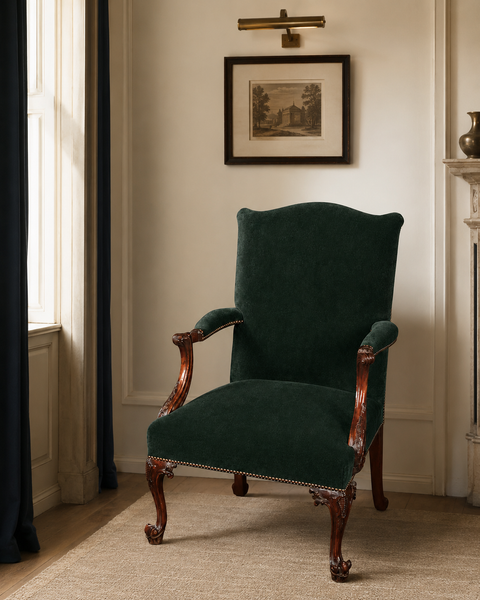
In 2026, the dominant upholstery choice in formal dining rooms leans toward deep tones, jewel-grounded fabrics, and performance-grade wovens. Dusty blues, bottle greens, and the full range of chocolate-adjacent neutrals are all working. The move away from white or pale dining chairs is complete. The rooms that look most considered today are the ones where the seat color deepens the wood rather than contrasting against it.
For rooms with a warmer palette, the shield-back Hepplewhite chair offers a slightly more refined silhouette. Our Hepplewhite furniture guide covers the historical distinctions and why the form has held up across centuries of changing taste.
A few practical notes on chair selection:
- Arm chairs at the heads, side chairs along the run. Two arm chairs and six to eight side chairs is the standard configuration.
- Seat height matters more than people realize. The standard dining seat height is 18 inches. Measure your table apron clearance before ordering.
- COM upholstery. If you have a fabric from another project you want to carry into the dining room, a custom maker will work from your own material. This is how designers achieve rooms that feel considered rather than assembled.
See EGA Home's dining chair collection for Chippendale, Hepplewhite, and Queen Anne forms in mahogany.
The Sideboard: Function Built Into the Room
The formal dining room without a sideboard is incomplete. Not aesthetically. Functionally.
The sideboard is where the room stores what it needs to operate: extra flatware, linens, serving pieces, wine and spirits, candles. When dinner is over and the table needs to reset, everything has a home. This is part of why formal dining rooms work as rooms rather than just furniture arrangements.
The design logic of the sideboard has been solved for a long time. The Hepplewhite serpentine sideboard, with its gently curved front and tapered legs, is one of the great Georgian forms, graceful without being fussy. The Chippendale sideboard with ball-and-claw feet anchors a more dramatic room. The Sheraton-influenced sideboard, with its reeded legs and subtle inlay, suits a room leaning toward the Federal period.
The matching sideboard question comes up often. Matching your sideboard to your dining table is not a decorating rule from 1987. It's a design principle. When the wood tones, finish, and carving vocabulary are consistent across the table, chairs, and sideboard, the room reads as designed rather than accumulated. Our dining table guide addresses this directly, and EGA builds matched dining sets to custom dimensions specifically because this is how clients get the result they're after.
Browse EGA Home's sideboards and buffets for serpentine, straight-front, and Chippendale forms.
Color, Light, and the Moody Dining Room
The designers building formal dining rooms in 2026 are not painting them greige.
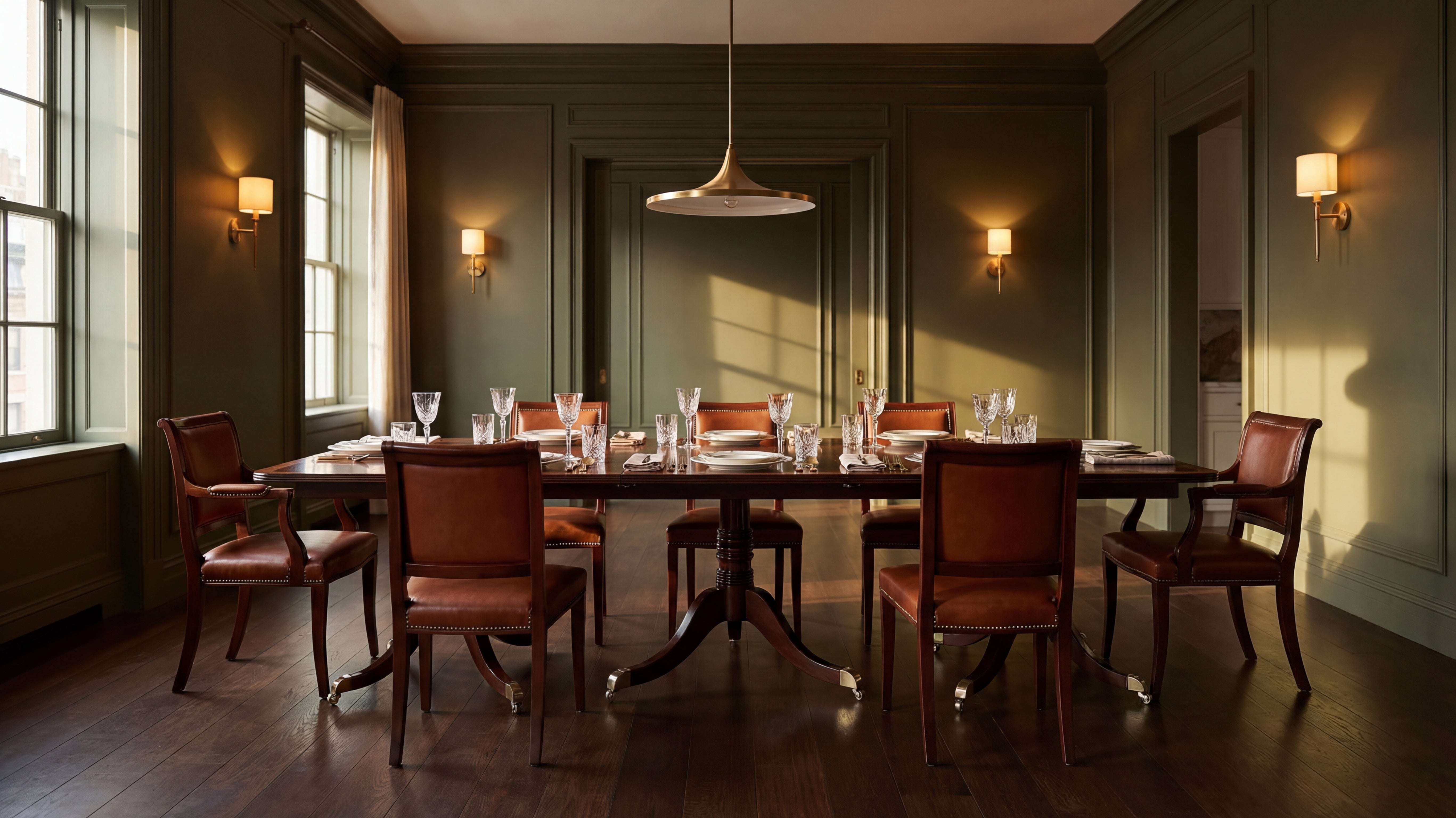
The palette that keeps appearing across design publications, client projects, and social media is dark. Deep chocolate browns, forest greens, burgundy, and charcoal. These are not dramatic choices. They're coherent ones. Dark walls do something specific for a dining room: they tighten the room visually, make the table feel like the center of something, and respond to candlelight in a way that pale walls simply don't.
If you want to push the room into that moody register:
Paint the walls and ceiling the same color. Color drenching eliminates the visual break at the cornice and makes the room feel immersive. A warm chocolate brown or deep forest green applied floor-to-ceiling transforms the room's scale.
Layer the lighting. A single overhead fixture is not enough. Sconces on the walls, candles on the table, and a statement fixture overhead create the kind of layered illumination that makes dinner feel different from lunch. The fixture doesn't need to be ornate. It needs to be dimmable.
Use the curtains. Tall, heavy curtains that puddle slightly on the floor add mass and formality without any furniture outlay. Dark linen or velvet in a tone pulled from the walls is usually right.
The dark mahogany dining table and the dark room are not in opposition. They complete each other. Mahogany at high polish reflects candlelight in a way that becomes the room's main spectacle. It's one of the reasons this wood has been the material of formal rooms for three centuries.
For more on working with dark wood throughout the home, our dark wood furniture living room guide covers the design principles in detail.
What "Matched Set" Actually Means
There's a version of "matched dining room set" that means three pieces from the same product line bought the same day. That's not what this is.
A genuinely matched dining room is one where the wood selection is coordinated. The artisan sourcing the mahogany for your table is sourcing from the same stock family for your chairs and sideboard. The finish is applied by the same hand. The carving vocabulary, the proportion of the leg, the profile of the molding, is consistent across every piece.
This matters for one reason: a room built this way reads as a room. Not a furniture arrangement, but a space that was conceived as a whole.
EGA Home builds to custom dimensions on every piece, which means a table made to fit your specific room can be matched to chairs at the exact seat height you need and a sideboard scaled to the wall it's going on. For clients doing a complete formal dining room, we coordinate the full set as a project.
The Formal Dining Room as Investment
There's an argument worth making directly: the formal dining room is one of the best return-on-investment rooms in the house, if it's built right.
A room furnished with genuine custom mahogany reproduction pieces, built to last and maintained simply, will not date. The forms are three hundred years old. They survived every furniture trend of the twentieth century and they'll survive the twenty-first. The room you build this year is the room your children argue over someday.
The alternative, buying trendy and replacing in seven years, costs more in the long run and produces nothing worth inheriting. The old money design sensibility is built on exactly this logic: buy the best version of the enduring thing, and stop buying.
Our old money interior design guide explores this mentality in full, including the specific pieces that define the aesthetic and why reproduction is often the better choice over authentic antiques.
Where to Start
If you're equipping a formal dining room from scratch, this is the sequence:
- Measure the room. Table first. You need 36 inches of clearance on all sides for comfortable movement. Know what length you're working with before you look at anything.
- Choose the table. This is the room's primary investment. Don't compromise here.
- Match the chairs to the table. Same carving vocabulary, same finish family. Upholster to the room, not the catalog photo.
- Add the sideboard. Match the wood. Size it to the wall.
- Address the room. Paint, lighting, curtains. These cost less than the furniture and do as much work.
The formal dining room is not complicated. It's just a room with a point of view: that dinner is worth a room of its own.
View EGA Home's dining tables | View dining chairs | View sideboards